
The U.S. Launches the Explorer I Satellite in the Space Race Against Russia: January 31, 1958
- Catholic Textbook Project

- Jan 26
- 3 min read
This text comes from our book, The American Venture.
It was under Eisenhower that the cease-fire that ended the Korean War was signed. Yet, though the United States engaged in no other wars in the Eisenhower years, the administration conducted covert operations in other countries. The chief instrument in these operations was the Central Intelligence Agency, or CIA. Though no war was declared, nor UN police action approved, the United States through the CIA helped topple and establish governments as far away as Asia, and as close to home as Central America.
In the congressional elections of 1954, the Republicans lost control of Congress, but in 1956, they kept the presidency when Eisenhower and Nixon again soundly defeated their Democratic challengers, Adlai Stevenson and Estes Kefauver of Tennessee. The Republicans, however, did not take control of either house of Congress, which remained Democratic. A Democratic Congress meant that it would be harder for Eisenhower to win passage for policies that required spending cuts. Yet, president and Congress agreed on extending certain social programs and on increasing funding for national defense, primarily against the Soviet Union. Government air-raid drills kept citizens worried about the possibility of conventional and nuclear war. These, together with reports that the United States’ nuclear war power lagged behind Russia’s, made Americans willing to accept ever-larger military expenditures.
The United States, however, did not lag behind the Soviets in its nuclear capability. By 1955, the U.S. nuclear stockpile was about 40 times that of Russia; by 1960, the United States had about 30,000 nuclear warheads to the Soviets’ 2,000. Throughout this period, too, the United States produced more Intercontinental Ballistic Missiles (ICBMs) than the Soviet Union and had more submarines and bombers dedicated to nuclear attack. ICBMs, developed by both the United States and the Soviets, could deliver atomic warheads over long distances, across oceans and continents.
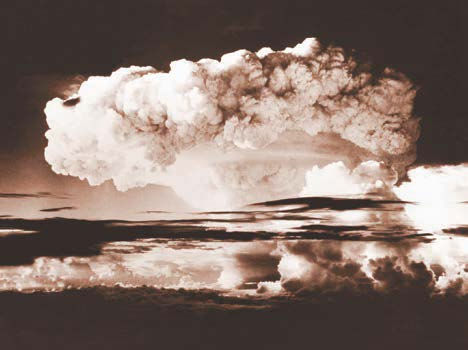
The period also saw the development of more powerful and deadly weapons. Already, under Truman, the U.S. had developed a bomb far more lethal than the atomic bombs dropped on Japan in 1945. This was the hydrogen or thermonuclear bomb, which the United States tested at Enewetak Atoll in the Pacific Marshall Islands in 1952. A year later, the Soviet Union tested its first hydrogen bomb.
The Soviets, however, seemed to be outstripping the Americans when, in October 1957, they launched Sputnik, the world’s first earth-orbiting satellite. The 183-pound, basketball-sized satellite orbited the earth in about 98 minutes. A month later, the Soviets launched Sputnik II, a heavier satellite that carried a dog named Laika. Americans feared that if the Soviets could launch such wonders, could they not easily bomb any place in the United States? An angry and fearful American public demanded to know why the government was allowing itself to be so outstripped by Communist Russia.
The United States answered the Russian challenge in January 1958 by launching a satellite, Explorer I. This lightweight craft was the first of a series of outer space craft. The Soviet challenge also led to an increase in scientific education in the United States. Congress approved the National Aeronautic and Space Act in July 1958, which led to the founding, three months later, of the National Aeronautics and Space Administration (NASA) to further research into and implementation of space exploration.


