
Spain Signs a Treaty to Cede Its Land East of the Mississippi to the U.S.: February 22, 1819
- Catholic Textbook Project

- Feb 23
- 3 min read
This text comes from our book, The American Venture.
Since resuming control of La Florida following the American Revolution, Spain had done little with the territory. Long gone were the days of the Florida missions, and far removed was the era of Spain’s glory and power. Revolutionaries in Mexico and South America were challenging Spain’s hold on the very lands that she had conquered over 300 years before. In Florida itself, Spanish power was especially weak, barely extending beyond the three fortresses of San Agustín (St. Augustine), Pensacola, and San Marcos (St. Mark’s) on Apalachee Bay. Outside these centers, the Spanish basically exercised no control.
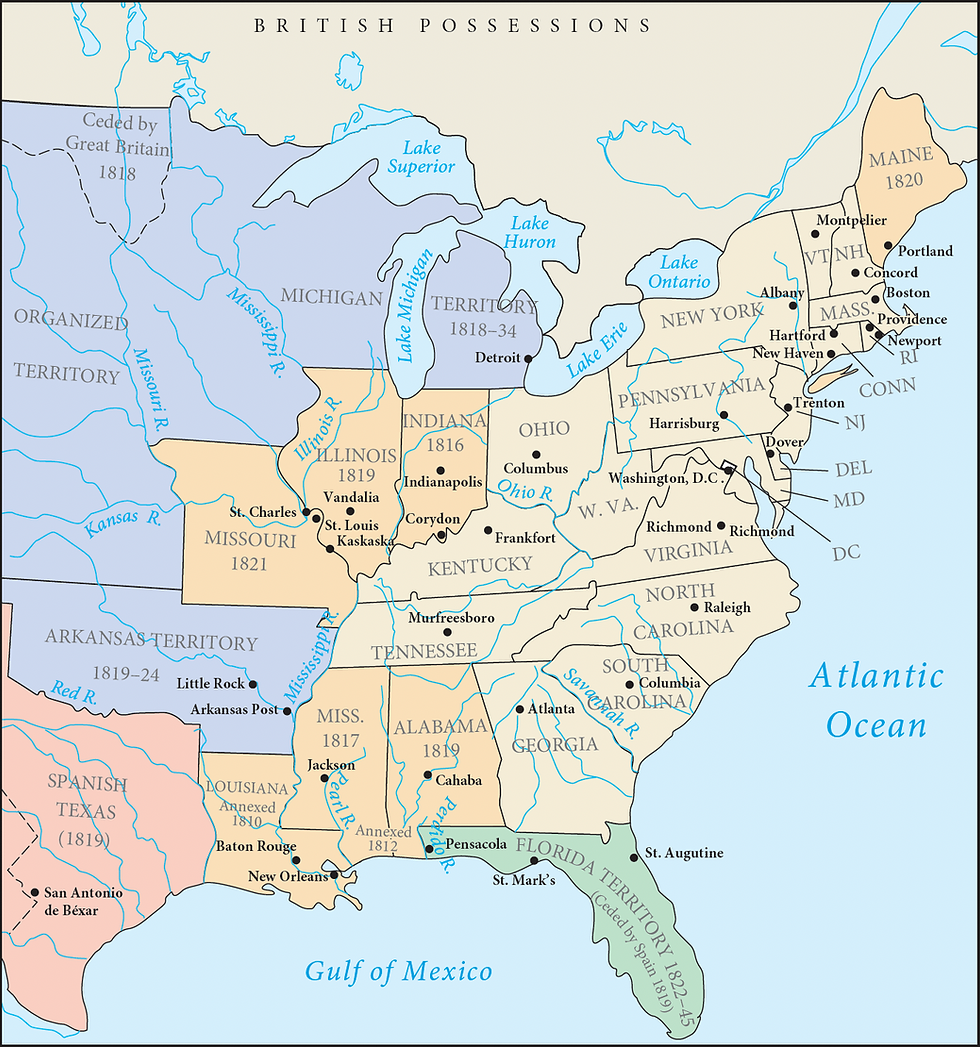
Florida had been a source of dispute between the United States and Spain since the Louisiana Purchase. The administrations of both Presidents Jefferson and Madison had insisted that the region called West Florida had been part of Louisiana and so belonged to the United States. Spain rejected this claim. But in 1810, settlers in the westernmost portion of West Florida (from the Mississippi River eastward to the Pearl River) seized the city of Baton Rouge and proclaimed their independence from Spain. In response, President Madison declared this region part of the U.S. Territory of Orleans (later called Louisiana). Two years later, the U.S. Congress did not wait for a revolt to annex West Florida between the Pearl and Perdido rivers. This region, which included Mobile Bay, was made part of the Mississippi Territory.
The lack of effective government in Spanish-held East Florida made the region a convenient haven for slaves escaping from plantations in Georgia. These slaves settled among the native Seminole people of Florida and intermarried with them. So it was that the Seminole were not happy that the U.S. Army periodically crossed into Spanish Florida, looking for escaped slaves. For their part, the Seminole, with groups of former slaves, crossed into Georgia, raiding plantations and stealing livestock. Full warfare between the United States and the Seminole, however, did not break out until 1816, when U.S. troops sent by General Andrew Jackson destroyed a fortified settlement of Seminoles and blacks, called the Negro Fort. Two hundred and seventy men, women, and children died in this assault.

The destruction of the Negro Fort sparked a frontier war. The Seminole under their leader, Bowlegs, raided white settlements in Georgia, killing settlers and driving away their cattle. In retaliation, U.S. troops attacked and destroyed Seminole villages. Never one to stop at half measures, General Jackson, with President Monroe’s permission, led Tennessee volunteers in an invasion of Florida. On April 7, 1818, Jackson and his men marched into San Marcos, hauled down the Spanish flag, and with U.S. naval forces as support, took possession of Apalachicola Bay. From San Marcos, Jackson set out south in pursuit of Bowlegs; but the chieftain and his men eluded him and escaped into the Everglades.
Foiled in his attempt to capture Bowlegs, Jackson was not in the temper to hear that Florida’s Spanish governor in Pensacola was protesting his invasion of Spanish territory. Jackson would teach that governor a lesson! Through the dense jungle forests, Jackson led his men to Pensacola near the furthest western edge of East Florida (in what is now the Florida Panhandle) where, on May 25, they captured the settlement, along with the Spanish governor and all his troops.

Jackson’s invasion of Florida, added to his exploits in the War of 1812, made him a hero in the American West. Such deeds would benefit him when, in 1824, he ran for president of the United States.
As for East Florida—despite Jackson’s “conquest” of it, the United States did not attempt to annex it. Nevertheless, after the war’s end in 1818, Spain saw that its weak hold on Florida could not last. On February 22, 1819, Spain and the United States concluded a treaty in which Spain sold all its possessions east of the Mississippi to the United States for $5 million. The Senate ratified the treaty two years later. In this way, East Florida became part of the United States.


