Samoset of the Wampanoag Tribe Greets the Plymouth Colonists: March 16, 1621
- Catholic Textbook Project

- Mar 16
- 3 min read
This text comes from our book, From Sea to Shining Sea.
A Haven for the Saints
In a city in Holland called Leyden lived a colony of Englishmen. These English men and women had come to live in Holland for only one reason: they wanted the freedom to practice their religion without interference from the government or anyone else. In England they had feared persecution from the king’s government because they refused to attend the services of the king’s church. In Holland no one would make them attend any church; Holland allowed its citizens to worship in any church they chose.
But even though they enjoyed freedom of religion, the English men and women, who called themselves the “Saints,” were not happy. They did not like it that their children were beginning to act more like Dutchmen and less like Englishmen. After 10 years in Leyden, the Saints decided they had to move elsewhere. But where would they go?

Why not Virginia? In those days, Virginia stretched from the Hudson River southward, so the Saints had plenty of choice places to settle. The Saints approached merchants in London to see if they could help them obtain some land in Virginia, around the mouth of the Hudson River. The merchants asked King James what he thought of allowing the “Saints” to settle in Virginia, and he thought it a fine idea. The king would allow them to settle along the Hudson River, or wherever else they wished, and he wouldn’t force them to be members of the Church of England. What more could the Saints want?
It was on September 6, 1620, that the Saints set sail from Plymouth harbor in England in a ship called the Mayflower. The Saints were not the only ones on the long sea crossing; in fact, most of the others were not Saints at all. This caused some troubles, for the Saints thought that their fellow passengers were not very saintly and worried that this might cause problems when they tried to form a colony in Virginia. To make sure the others would behave themselves in their new home, the Saints wrote out laws to govern their colony. The Saints and the other settlers together signed on to this list of laws, which became known as the Mayflower Compact.

After a two-month voyage, the Mayflower finally landed in America. Unfortunately, it was not Virginia where they anchored, but a land even farther north than the Hudson River country. It was a land colder than the lands around Jamestown, far colder than anything the colonists had known in England. November had arrived, and the colonists had hardly enough time before winter came to set up their settlement (which they named Plymouth). None of them had ever known so bitter a winter. By its end, nearly half of the Plymouth colonists had died.
Unlooked-for Help
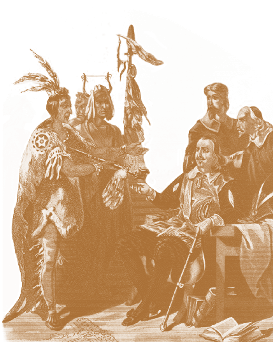
One day in March 1621, after the worst of winter had passed, the Plymouth colonists were surprised to see two Indians come into their settlement. Up to then, the colonists had had no contact with Indians. What was their surprise, then, when one of the Indians spoke to them in English! This Indian was named Samoset. Samoset belonged to the Abenaki tribe that lived further north, in what is now Maine. He had learned English from Englishmen who had come to fish in the waters near his home.
Samoset told the colonists that he would introduce them to Massasoit, the chief of the Wampanoag tribe, who lived around Plymouth. Samoset arranged a meeting between the colonists and Massasoit. The Indians and the English signed a peace treaty. Moreover, the powerful Massasoit told his people to befriend the English. The Indians taught the colonists how to farm in the new country that was now their home. The colonists benefited from the maize (corn), beans, squash, and Jerusalem artichokes grown by the Indians.

That summer, the colonists planted the crops that gave them an abundant harvest in the autumn. In October the colonists prepared a harvest feast in order to give thanks to God for all his blessings. Massasoit and other Indians came to this feast. It is this feast Americans today remember on Thanksgiving Day.