
German Leaders Establish the Italian Social Republic: September 23, 1943

This text comes from our book, Light to the Nations, Part II.
The year 1943 marked the beginning of the period of Allied victory, which included increased Allied attacks on the German homeland. Beginning in March 1943, the RAF began bombing cities in the industrial Ruhr region of Germany. The planes dropped their bombs on city centers, which burned more quickly than outlying areas. In July, the RAF began firebombing cities. In Hamburg the bombing created a firestorm that destroyed one-half of the houses in the city and killed 50,000 inhabitants. In November the RAF and the U.S. Air Force began round-the-clock bombings over the German capital of Berlin. The bombs eventually destroyed three and one-half square miles of the city.
While the Allied air forces carried out their bombing raids, General Eisenhower and 250,000 Allied troops opened the invasion of Sicily. In July, the Allied Seventh Army under General Patton swept across the island, and on July 22, they entered Palermo on the north coast of Sicily. By August 17, all of Sicily was in Allied hands. The stage was now set for the invasion of the Italian peninsula.
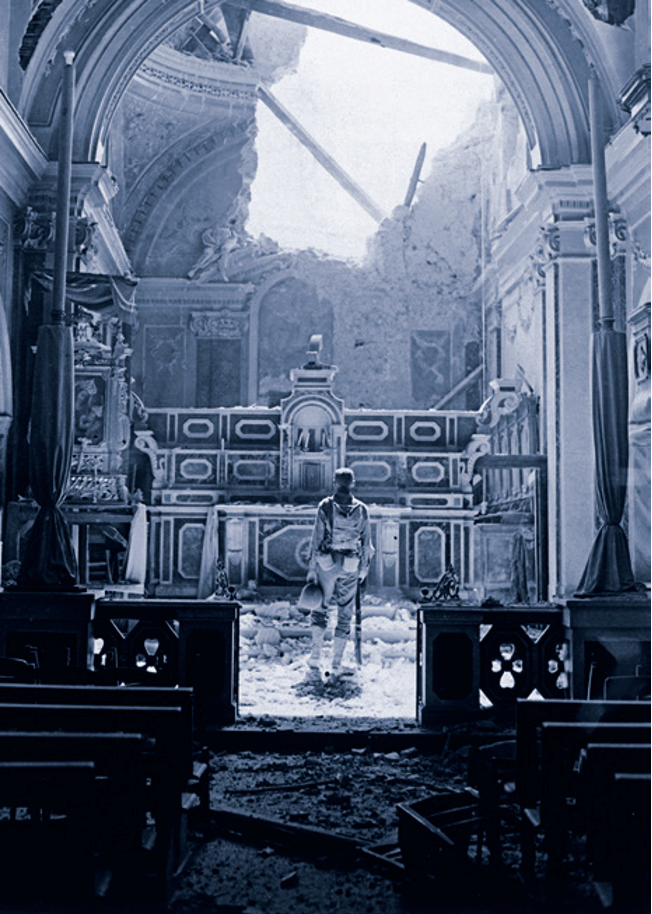
By this time, the Italian people were thoroughly sick of the war and of the man who had gotten them into it—Benito Mussolini. The war had not made Italy a great empire; it had brought only defeat, disaster, and death. On July 9, 1943, a fleet of 560 Allied planes had dropped bombs on Rome. Italians—even Fascists—were ready to surrender. On July 24, 1943, the Fascist Grand Council agreed to ask King Vittorio Emanuele III to take control of the government. The next day, the king forced Mussolini to resign as prime minister and had him arrested. In Mussolini’s place, the king appointed Marshal Pietro Badoglio, who immediately began to seek peace terms with the Allies—though in secret, for fear of the Germans.
Because of the Allies’ policy of unconditional surrender, Italy did not agree to surrender for several weeks. Negotiations dragged on into early September, which gave the Germans enough time to move reinforcements into Italy. When Italy formally surrendered to the Allies on September 3, 1943, the Germans held important positions in Italy, including Rome, and the Italian army was powerless to resist them. King Vittorio Emanuele, along with members of his government, fled from the capital and sought Allied protection. On September 23, the Germans established the Italian Social Republic under Mussolini’s leadership. Il Duce, who had been freed from prison, did not want to lead the new government, but Hitler threatened to destroy Milan, Genoa, and Turin if he did not. Mussolini thus became the prime minister of an Italian state completely under Hitler’s control. On October 13, the government of King Vittorio Emanuele formally declared war on Germany.

In mid September, German forces obstinately contested the Allied advance but could not stop the Allied capture of Salerno, in southern Italy. Having established a beachhead, the Allies began their pursuit of the German army, which made an orderly retirement northward. After Allied forces seized Naples in October, only 100 miles lay between them and Rome. But it was a difficult 100 miles, for the Germans had a strong defensive line and were able to hold back the Allies for eight months. Unable to break the German lines, the Allies attempted another landing at Anzio, to the north of Naples, on January 22, 1944. The Allies hoped by doing this they could draw off some of the German forces. But another German force, unknown to the Allies, met them at Anzio, and the attempt to break the German line failed.
In May 1944 the Allies were finally able to push the Germans from their lines south of Rome. In withdrawing from their position, the Germans abandoned Rome and formed a new line north of the Arno River. On June 4, 1944, the victorious Allies liberated Rome.


